
Expert time is scarce
Assigning signals by hand takes years of experience and hours of attention for every compound.
NMR structure elucidation platform
Upload a spectrum and let our bespoke machine learning algorithms propose candidate structures. Refine them in an interactive workspace, check the predicted ¹³C spectrum against your data, and do it together with your team. All the computing runs on our side.
The problem
Assigning signals by hand takes years of experience and hours of attention for every compound.
Predictors, sketchers and 3D viewers live in separate programs, each with its own licence and installation.
Running ML models or simulations takes hardware and administration that most labs simply don’t have.
Students learn to read spectra from static textbook figures instead of working with real, interactive data.
How it works
Drop a JCAMP-DX file, including Bruker variants. Set the spectrometer frequency, tune the baseline, mark solvent peaks and let automatic peak detection do the rest.
Our models read the peak list and propose candidate structures. Each one is built from chemical groups you can inspect, so you never get a black-box answer.
Edit at the level of chemical groups or individual atoms. The two views stay in sync, and a library of 374 named groups labels every piece of the molecule.
Predict the ¹³C spectrum of your candidate and overlay it on the measured one. Compare candidates side by side and keep the structure that fits.
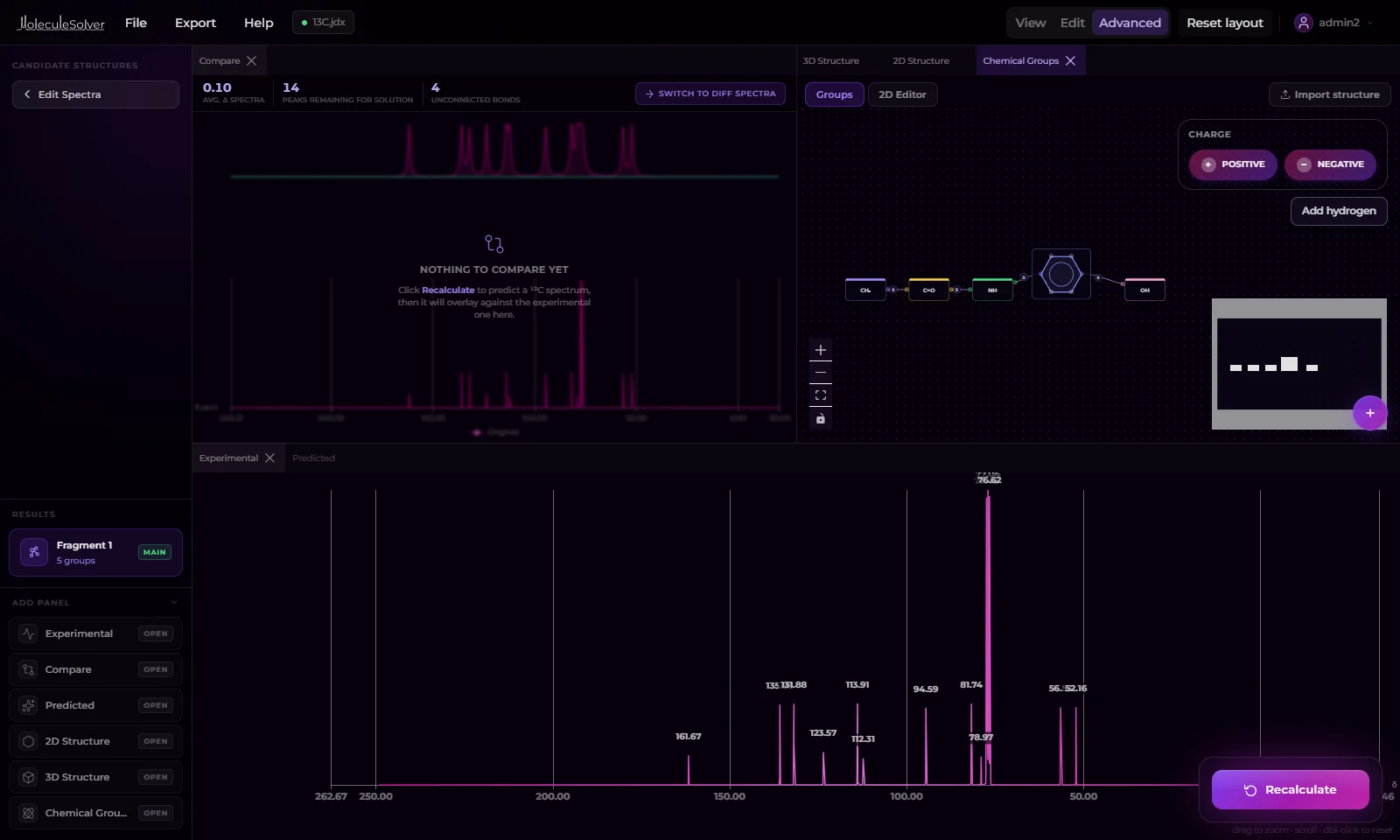
The workspace
Groups, atoms, spectra and 3D in one place. Every edit is reflected everywhere at once.
Draw or edit atoms and bonds directly, and the molecule is decomposed back into named chemical groups automatically.
Search by name, alias or SMILES, or browse by category, from methyl to morpholinyl.
Type “paracet…”, pick paracetamol and it lands on the canvas. You can also paste SMILES or InChI. The lookup runs on our own index, so your queries never leave the platform.
Rotate and inspect every candidate structure in 3D, right next to its spectrum.
Choose how a molecule is cut into groups, from retrosynthetic rules to the fragments a spectroscopist would pick.
Collaboration
Share a workspace the way you share a spreadsheet. Everyone sees the same spectrum and the same candidate, and every edit appears live.
 Anna
Marek
Prof. Kim
Anna
Marek
Prof. Kim
Learning mode
Guided exercises on real spectra teach you to read shifts, recognise groups and reason your way to a structure, with feedback at every step.
Which peak belongs to the C=O carbon?
Compound: naproxen
Pick a peak on the spectrum or a value below.
Compute included
No GPUs, no installation, no software licences. Open a browser, and the machine learning algorithms, NMR prediction and soon molecular simulations run on MoleculeSolver’s own hardware.
Everything runs in the browser: no installers, no licence servers, no waiting on IT.
Models and simulations run on machines we operate ourselves, not on a patchwork of third-party services.
Heavy computation happens on our servers, so even a student laptop is all you need.
Coming soon
Once your structure and its spectrum agree, take it further in the same workspace, on the same compute.
Molecular mechanics and dynamics for your candidate structure, set up in a few clicks.
Simulate how your molecule behaves in contact with a complete cell membrane.
Check how a candidate ligand binds its protein target before you ever reach the bench.
Partners


Team

CEO & Co-Founder
Trained in biotechnology and computer science and working professionally as an automation developer, Rafał connects laboratory practice with software engineering and leads the company’s strategy.

CTO & Co-Founder
A solution architect with many years of industry experience, Michał is responsible for the platform’s architecture, scalability and technical roadmap.

CRO & Co-Founder
Holding a master’s degree in machine learning, Jan leads research into new methods for structure elucidation and turns them into the models behind the platform.

COO & Co-Founder
Holding a master’s degree in artificial intelligence, Albert develops the platform’s machine learning models and oversees day-to-day operations and delivery.